About My Work
Techniques and Philosophies
When I was teaching communication design, I used to tell my students that talking about visuals is often less valuable than just looking at them. The work should speak for itself. I believe this holds true for art as well.
If a piece doesn’t resonate with you directly, no amount of explanation will change that. Background information can enhance understanding, but it can never replace the direct communication between the artwork and the viewer. I’ve often found that viewers connect with a piece in ways that differ entirely from my original intention — and that’s perfectly fine. Who am I to dictate what others should feel?
That said, for those interested in the ideas and processes behind the work, here are a few thoughts.
|

Color swatches of mineral pigments on my studio wall

Drawing Ensō as an active meditation
Philosophy
My work is rooted in the present moment — in the awareness of what is happening right now, and the act of leaving a mark. Whether that mark is a large gesture or a small dot, it is a document of this very moment, and the quality of attention brought to it.
In this sense, the work spans from Taograms — snapshots of a single moment — to Breath Meditation Diaries, where accumulated layers become strata of moments, compressed into a single surface.
⸺
Ink, paper, time, water, and air are as much a part of the final result as I am. Letting go of control is not a weakness but a condition — one that allows the work to become more than what I alone could make. We should take more responsibility for our decisions, and at the same time take ourselves less seriously as the measure of all things.
The rhythm and repetition in my work stand for the eternal cycle of becoming and passing — breath, seasons, time. And simultaneously for the infinite diversity and individuality of every being. We are all alike, and yet no two marks are the same. Inseparably connected, and irreducibly singular.
⸺
Philosophically, the work is rooted in the tension between opposites — perfectionism and the love of natural imperfection, control and surrender, the singular mark and the infinite whole. Concepts like Wabi-Sabi and Shibui are not references but lived principles, present in every material decision and every gesture.
I am a firm believer in beauty — not beauty as decoration, but as purity. There is an archetypal beauty that everyone can connect with, just as there is an unalterable truth within each of us. That is what I seek.
|
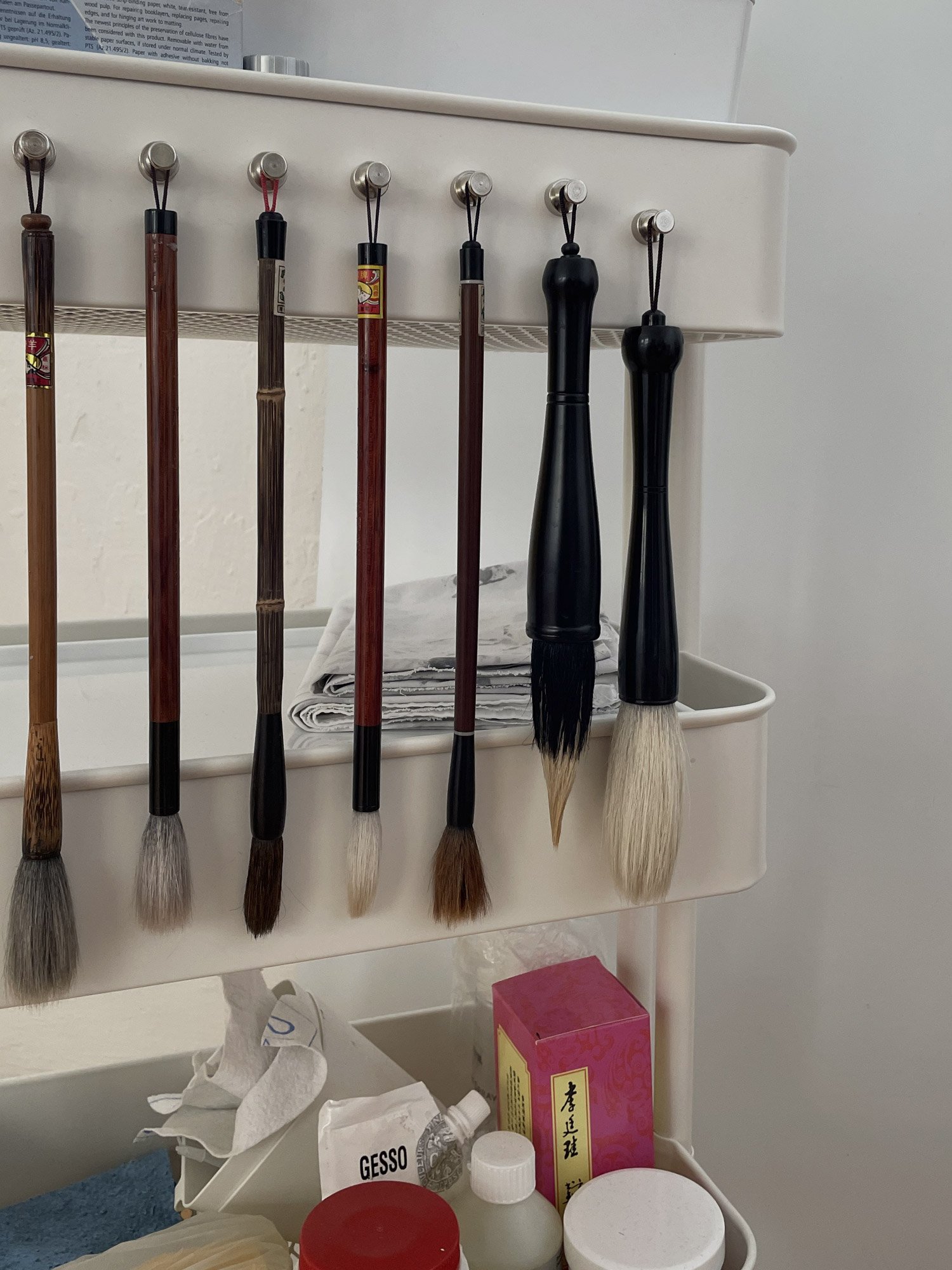
Natural hair brushes of different sizes
Materials
My early career began with papercuts, then acrylics and enamel. It wasn‘t until my late thirties that I encountered Sumi ink and Washi paper — a meeting that profoundly transformed my practice.
⸺
Today, I work almost exclusively with natural materials: Japanese Washi paper made from Kozo fibers, Sumi ink, and mineral pigments sourced from soil, stone, and plants — bound with Nikawa, a traditional animal glue. The white pigment, Gofun, is made from oyster shells. I realized only recently, in conversation with a fellow artist, that my entire process — from A to Z — is 100% natural. I didn‘t plan it that way. I‘m grateful it evolved like this.
I use a variety of natural hair brushes — goat, wolf, horse — as well as pipettes, cotton swabs, and sticks, depending on what the work requires.
|
<

Mixing pigments with Nikawa

Work in progress on my studio wall
Process
Once a work on paper is complete, it is wet-mounted onto a second sheet of Washi using Shofu Nori — a paste cooked from wheat starch — in a technique called Urauchi, used in Japanese art and book restoration for centuries. This flattens and stabilizes the work, preserving its archival quality.
For wood panels, the surface is prepared with layers of Gofun and Nikawa before a sheet of Kozo Washi is mounted using the same Urauchi method. A previously completed painting can then be mounted onto this surface using the same Urauchi method.
The final touch is the signature: pencil first, then sealed with cinnabar paste using a Hanko carved from black horn.